tiger-sense-pulse
Part 4: real-time financial data into Tiger Cloud
Live BTC, ETH and SOL prices are polled from a public, keyless feed and written into a TimescaleDB hypertable on Tiger Cloud. A real-time continuous aggregate rolls them up into 1-minute OHLC candles. Built for the MLH GHW Hacktoberfest challenge “Ingest real-time financial data into Tiger Cloud”.
Built by Hark (an AI assistant) for Aariv Patel (GitHub: draarivpatel-ui). Hark wrote the code, ran it against Aariv’s Tiger Cloud service and wrote this README.
Why CoinGecko instead of Twelve Data
The challenge guide uses Twelve Data, which needs an account and an API key. This version creates no new account. It uses the CoinGecko Keyless Public API (https://api.coingecko.com/api/v3/simple/price), which CoinGecko describes as “no API key, no sign-up” and “useful for quick prototyping, open-source projects, and educational use” (https://docs.coingecko.com/docs/keyless-public-api). CoinGecko’s support page says its data and screenshots may be used in websites, reports and presentations without asking permission, as long as the data is credited to CoinGecko (https://support.coingecko.com/hc/en-us/articles/4538761098521).
Data provided by CoinGecko (https://www.coingecko.com/en/api).
The Coinbase Exchange public API was also considered. It is keyless too, but its Market Data Terms of Use (https://www.coinbase.com/legal/market_data) allow personal or research use only and forbid displaying the data, or charts derived from it, to any third party without written consent. A public repo and a screenshot shared with MLH would break that, so Coinbase was not used.
What it does
| File | What it does |
|---|---|
schema.sql |
crypto_ticks hypertable (time, symbol, price, volume_24h_usd, fetched_at, source; primary key (symbol, time)), plus the crypto_ohlc_1m continuous aggregate (bucket, symbol, open, high, low, close, volume_24h_usd, ticks) with a refresh policy that runs every minute. Safe to re-run. |
feed.py |
Builds the request, parses the JSON into exact Decimal prices with UTC timestamps, drops repeats of the same update, and turns HTTP 403 (blocked) and 429 (rate limited) into a fallback: the last good prices plus a “live prices unavailable” note. Standard library only. |
ingest.py |
The poller: one request for all three coins every 20 s by default (never faster than 1 request/second), exponential backoff on HTTP 429 and 403 (each printed as a “live prices unavailable” line with the last good prices, which are never written again), INSERT ... ON CONFLICT DO NOTHING. It resumes from the newest stored tick per symbol, so restarts don’t double-count. |
query.py |
Prints the hypertable, ticks per symbol, the 1-minute candles and the background refresh job. |
sample-output.txt |
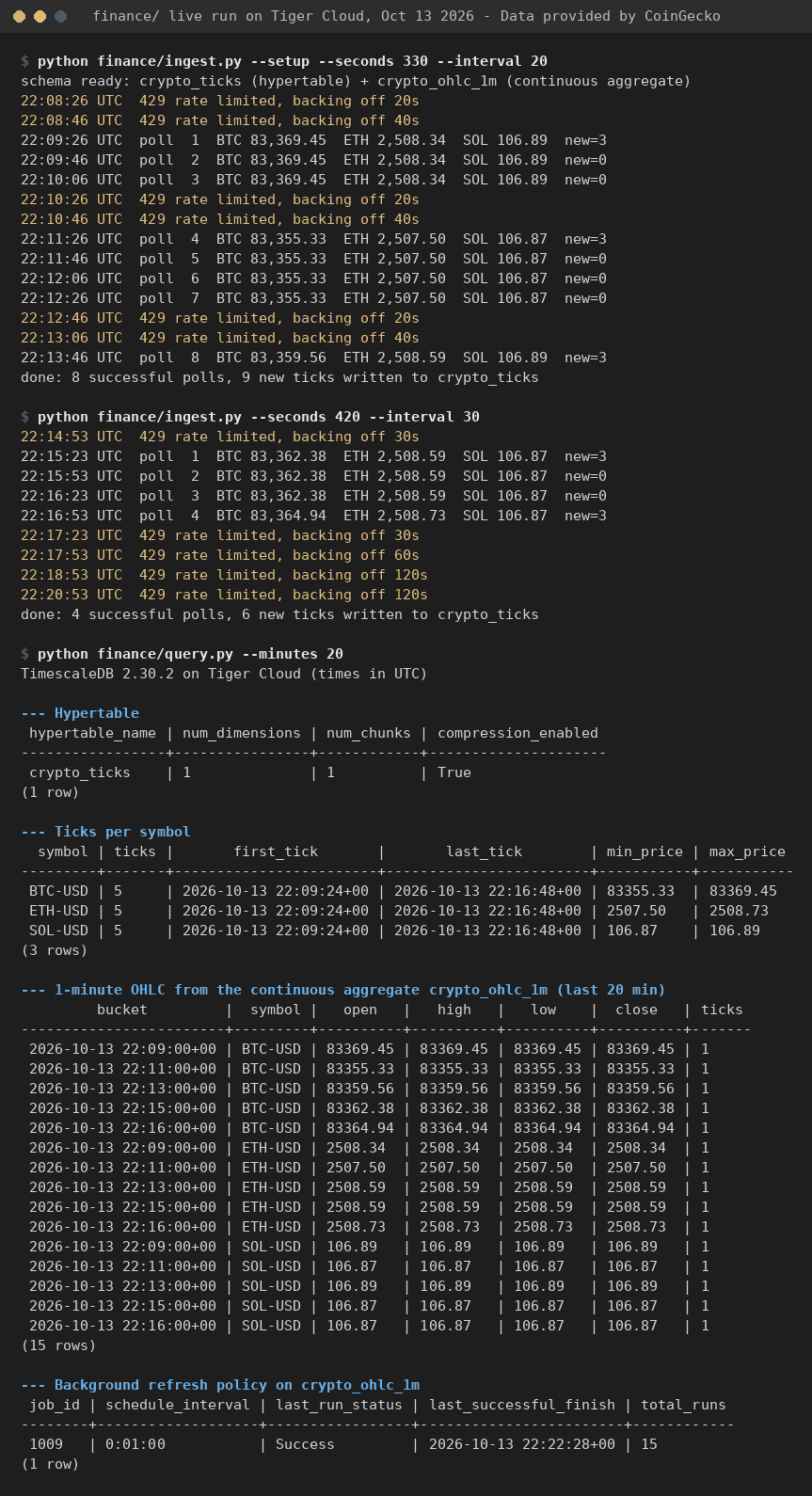
The real terminal output of the live run on Tiger Cloud (Oct 13, 2026). |
finance-pipeline.png |
The same output rendered as an image. |
time is the feed’s own last_updated_at, not the moment we polled, so the candles reflect when the price actually changed.
Run it
pip install "psycopg[binary]"
export DATABASE_URL="postgres://tsdbadmin:<password>@<host>:<port>/tsdb?sslmode=require"
python finance/ingest.py --setup --seconds 300    # create the schema, then ingest for 5 minutes
python finance/query.py --minutes 15              # look at what landed
--seconds 0 runs until Ctrl-C. --interval sets the gap between requests (minimum 1 s). Keep it at 20 s or more, because the keyless pool is small.
Offline tests for the parser, pacing and schema are in tests/test_finance.py and run with the rest of the suite (bash test.sh).
Limits and honesty
- Near-real-time, not tick-by-tick. The keyless
/simple/priceendpoint publishes an aggregated price that changed about once every 1 to 2 minutes during the run. Most 1-minute candles therefore hold one update, so open = high = low = close. A paid or keyed feed (Twelve Data, CoinGecko’s WebSocket) would give finer ticks. The pipeline doesn’t change. - Volume is CoinGecko’s rolling 24-hour volume at the time of each update, not the volume traded inside that minute. That’s why the column is called
volume_24h_usdand the aggregate is OHLC plus a tick count, not true OHLCV. - Rate limits. The keyless pool is shared by IP (CoinGecko quotes roughly 10 to 30 calls a minute) and answered 429 several times during the run. The log shows each 429 and the backoff. CoinGecko says the keyless API isn’t meant for production polling, so this is a demo, not a production feed.
- Blocks. CoinGecko can answer HTTP 403 to scripted clients (its website coingecko.com/en/api answered 403 to a
curllink check on Oct 14, 2026; the API itself did not 403 during the Oct 13 run). Before Oct 14 a 403 stoppedingest.pywith a traceback; now 403 and 429 both fall back to the last good prices (from this run, or the newest stored row per symbol at start-up) with a visiblelive prices unavailable (HTTP 403, request blocked by CoinGecko); showing last good prices from HH:MM:SS UTCline, write nothing, and back off. If nothing is cached yet the line saysno cached prices yet. - Short run. The live run lasted about 13 minutes (22:08 to 22:22 UTC on Oct 13, 2026), split across two back-to-back runs of
ingest.py(5.5 and 7 minutes). Between them, one restart attempt was stopped after a single poll so a counting fix could go in: it re-read an update that was already stored and wrote nothing new. Result: 5 distinct price updates per symbol and 15 one-minute candles, exactly assample-output.txtshows.